Are We All Going to Die in Trump and Israel's Nuclear War
Can we at least wait til climate catastrophe kills us

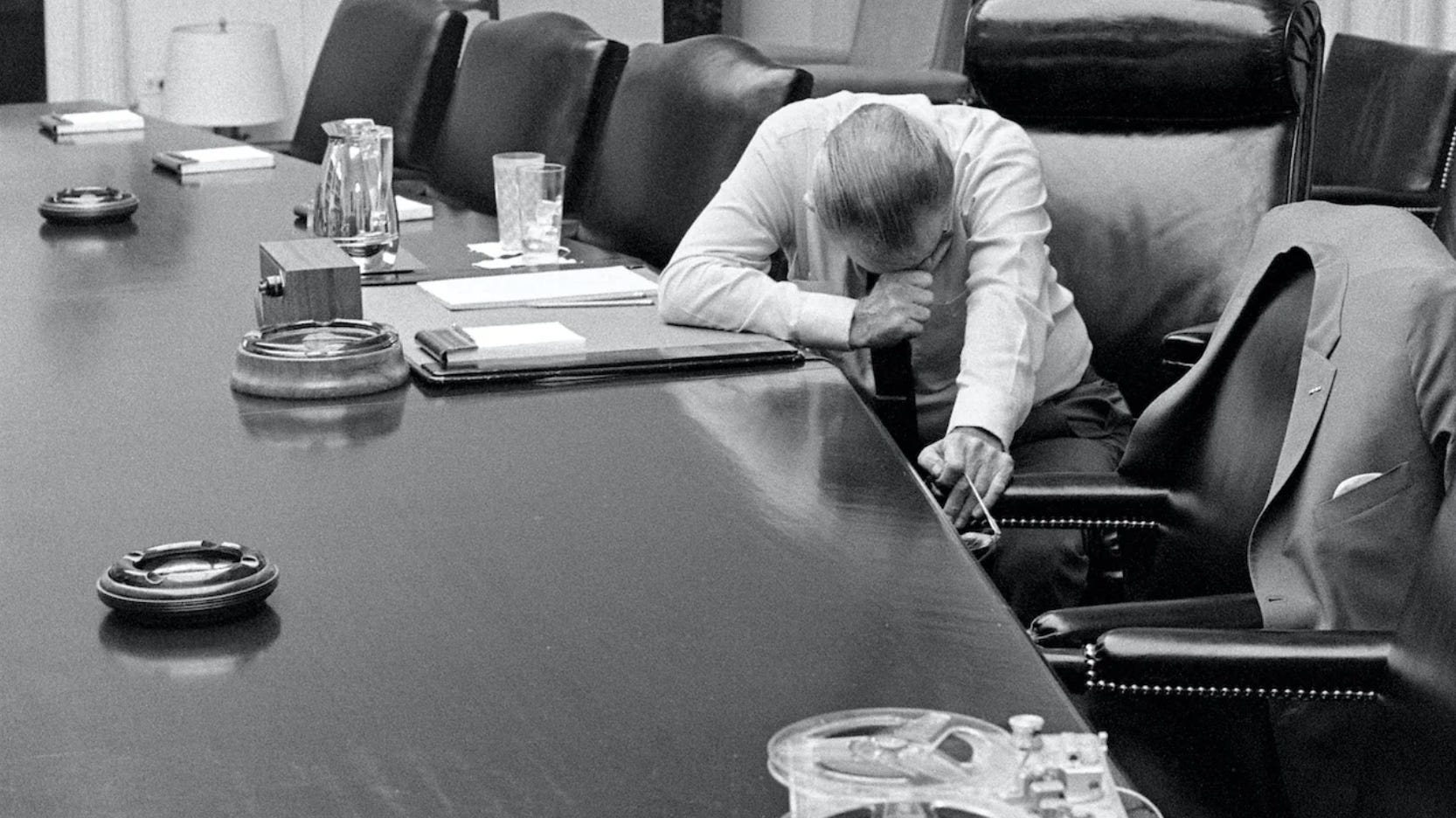
I came across that famous photo of Lyndon B. Johnson in the Situation Room—4 a.m., alone, listening to tapes from Vietnam, poring over casualty reports. Johnson helped create that war. He owned it. And yet there he is, awake in the middle of the night, reading the names of the dead, grieving the Americans who wouldn’t be coming home. (Not the Vietnamese—tragically, his empathy apparently stopped at the water’s edge. But still: there was something there. A human response.)
That image says more than a thousand speeches ever could. It shows a president who, however flawed, understood that sending people to die is a moral burden, not a performance. Not fun.
Now ask yourself: can you picture Donald Trump doing that? Sitting alone at 4 a.m., reading the names of the dead, feeling the weight of it?
Of course not. Not Trump. Not Pete Hegseth. Not any of the chest-thumping crowd that treats war like a cable news segment. These are people who don’t mourn the dead—they instrumentalize them. Their instinct isn’t grief; it’s spectacle. Their language isn’t tragedy; it’s victory laps.
And it’s not just here. Look at Benjamin Netanyahu. Can you imagine him lying awake, broken over the deaths of Israeli soldiers sent into unwinnable missions? Can you imagine a flicker of genuine sorrow for Palestinian civilians, for Lebanese families, for Iranian innocents, for anyone on the other side of the line—given his indifference to his fellow Israelis?
No. Because in this worldview, those deaths aren’t tragedies—they’re acceptable, even useful. They are the price of power, and power is the only currency that matters.
That’s the real danger. Not just bad policy. Not just reckless escalation. But the absence of empathy at the highest level of decision-making. When leaders no longer feel the human cost of their choices, there is nothing left to restrain them.
History has already shown us how close we came when that restraint was all that stood between survival and annihilation. During the Cuban Missile Crisis, it wasn’t brilliance or strength that saved the world—it was empathy. It was thoughts of millions of dead. It was the capacity of men like John F. Kennedy and Nikita Khrushchev to imagine the consequences of pushing the button.
Take that away—strip out the empathy, the imagination, the basic human recoil from mass death—and what’s left is pure, unbounded danger.
That’s why this moment feels so much more perilous than people want to admit. Because if you put the power of nuclear weapons in the hands of someone who sees destruction not as a last resort but as a demonstration of strength, you are gambling with everything.
We’ve seen this mindset before in history. It ends the same way every time: with leaders so consumed by their own mythology that they would rather destroy the world than admit failure. (If Hitler had nuclear weapons during those last days in the Führerbunker, can you doubt he would have used them?)
Trump and Hegseth have thousands.
The only question that matters now is the simplest—and the most frightening:
Who, exactly, is left to stop them if Trump—a demented sociopath—gives the order? “Let’s do this.”
It's now becoming impossible to try and find the right words to describe my feelings about the men that are prosecuting this abhorrent war.
I hope that the future commentators, scholars and those that hold power will find the appropriate language that these monsters deserve.
Visited the LBJ Museum in Austin during Trump 1. For all LBJ’s faults, while watching the presentation about him in the Introductory Theatre, tears welled up in my eyes as I thought about the contrast with that soulless narcissist Trump.